marți, 25 ianuarie 2011

Religion's influence on DREAM Act, Don't Ask Don't Tell

Religion's influence on DREAM Act, Don't Ask Don't Tell

It's a big day on Capitol Hill. Congress is expected to vote on the DREAM Act (Development, Relief and Education for Alien Minors Act), a proposal to allow young immigrants to become permanent residents by getting a college degree or serving in the military, and the repeal of Don't Ask Don't Tell, the policy keeping gays from openly serving in the military.
The DREAM Act
The DREAM Act has gotten support from religious groups who see immigration reform as a way to offer grace and mercy to children of undocumented workers, who don't have the opportunity to earn legal status on their own. The Texas Catholic Conference issued an alert this week encouraging Catholics to support this legislation.
When asked about the how the government should address immigration, 42 percent of Hispanic Catholics said creating a path to citizenship should be a priority over improving border security, according to a Pew Research Center survey conducted over the summer. About a quarter of all Catholics favor creating a path to citizenship.
White evangelicals and mainline Protestants were most likely to favor better border security instead--although some evangelicals, particularly those from multi-ethnic congregations--have also launched campaigns for the DREAM Act. They site scriptural references to caring for aliens in a foreign land, like this passage from Exodus, "You shall not wrong a sojourner or oppress him, for you were sojourners in the land of Egypt."
In Houston, Cardinal Daniel DiNardo has joined with the Rt. Rev. C. Andrew Doyle and other prominent religious leaders to speak out about immigration in general. The Pew survey found that a quarter of people who attend services regularly have heard clergy address the issue from the pulpit.
DADT
Although the repeal of Don't Ask Don't Tell is expected to fall just short of being voted into law (due to not gaining the support of a single Republican representative), a majority of Americans across religious traditions favored the repeal of the 17-year-old ban.
According to the Pew research, "Large majorities of white mainline Protestants (68%), white Catholics (71%), Hispanic Catholics (60%) and the religiously unaffiliated (66%) favor allowing gays and lesbians to serve openly in the military, while support is lower among white evangelical Protestants (43%) and black Protestants (46%). Even among the least supportive religious groups, though, less than half oppose allowing gays and lesbians to serve in the military."
For religious traditions who equally include GLBT populations, the issue is ending the discrimination against them in the services and securing them an equal position.
A letter drafted by the Religious Institute, a group dedicated to promoting sexual justice, argued in favor of the repeal:
"There can be no turning back from the goal of the full participation of lesbian, gay, bisexual and transgender people in our faith traditions and communities. We recognize that this work may challenge beliefs and unsettle relationships, but it goes to the heart of our mission as faith communities: to create the conditions so that each person can flourish."
The letter was signed by 500 clergy members across faith traditions.
When Congress proposed repeal Don't Ask Don't Tell back in the spring, military chaplains were among the bill's opponents.
"By raising homosexual behavior to the same protected status as innate, innocuous characteristics like race and gender, the armed forces will cast the sincerely held religious beliefs of many chaplains and Service members as rank bigotry comparable to racism," a group of chaplains wrote in a letter to the president and defense secretary.

Twenty years after the death

Twenty years after the death of its high priest, reggae still informed the vocabulary of music. Reggae had so thoroughly infiltrated pop, rock, hip hop and electronica, we hardly noticed it any more. Still don't.
And if it isn’t in the music itself – the bass lines, off-accent drumming, choppy guitars – then it's in the attitude reggae producers such as Lee Perry, King Tubby, Clement Dodd and others brought to what was possible in a studio. Yes,Bob Marley may be gone -- and Peter and so many more -- but the musical message they brought lives on everywhere.
Well, almost everywhere.
No one seriously expects classical musicians to explore reggae riddum (although there’s no reason why they shouldn’t and the Reggae Philharmonic Orchestra had a decent stab at it) and jazz was particularly tardy in tuning in. Certainly down the years there were jazz musicians who tuned to reggae, most notably sax player Oliver Lake who in 1978 (around the time of Bob's Kaya) recorded the track Change One, which had an unmistakable Caribbean influence.
Lake, who co-founded the Black Artists Group in St Louis in 1968 after being inspired by Chicago’s AACM, always had an interest in Caribbean music, but a trip around the islands in '80 confirmed for him there was a rhythmic pulse worth delving into seriously.
He formed Jump Up, a lively jazz-dance band which took off into reggae and back-to-Africa styles. Throughout the early and mid Eighties, Jump Up (in vibrant multi-coloured stage outfits in the manner off the Art Ensemble of Chicago) were something of a sensation and even now their self-titled debut and Plug It albums are worth tracking down.
However Lake also played in the World Saxophone Quartet and other projects which became more successful so Jump Up withered and faded.
Bassist Jamaaladeen Tacuma also explored reggae around the same time and UK saxophonist Courtney Pine, who grew up on the stuff, always used it as a springboard.
There have been others too -- London’s Jazz Jamaica was more JA-UK-MOR than jazz however – but surprisingly few.
Most visible has always been guitarist Ernest Ranglin, the man many say invented ska in Coxsone Dodds' Jamaican studio in the late Fifties.
In '59 Ernest Ranglin recorded the young Bob Marley, but his most visible ska hit was My Boy Lollipop with Millie Small in '64.
Ranglin told me ska never had the opportunity to be taken further because the producers wanted to keep hits coming by not messing with the choppy, addictive formula. So he headed to London and Ronnie Scott’s jazz club, and to this day insists he is a jazz musician, but one with a foot in reggae. He toured with Jimmy Cliff in the Seventies and latterly recorded excellent reggae-conscious jazz albums: Below the Bassline from '97 featured pianist Monty Alexander and Memories of Barber Mack from the following year had Sly Dunbar on drums.
Ranglin has the reggae spirit within him.
And so does Alexander, whose Goin' Yard in '01 completed a trilogy of reggae-jazz recordings which began with Stir it Up from '99 where he played Bob songs, and Monty Meets Sly and Robbie. Alexander incorporates nyabinghi rhythms, melodica, the breezy JA-vibe and fat-bottom bass into his jazz-reggae and never sounds anything less than authentic, and unique.
Should any hardcore jazz head doubt Alexander‘s credentials, we need only note the Jamaican-born pianist also played with Milt Jackson, Dizzy Gillespie and Sonny Rollins.
Goin’ Yard, recorded live in Pittsburgh, is at its best when he dug into Augustus Pablo's King Tubby Meets the Rockers Uptown, and creates epics out Marley's Could You Be Loved and Exodus, the latter opening with him weaving into the melody via the famous theme to the movie of the same name.

The moment when Dorothy

The moment when Dorothy passes out in monochrome Kansas and awakes in Technicolor Oz may have been more significant than you'd ever imagined. A new study reveals that children exposed to black-and-white film and TV are more likely to dream in greyscale throughout their life.
Opinions have been divided on the colour of dreams for almost a century. Studies from 1915 through to the 1950s suggested that the vast majority of dreams are in black and white. But the tides turned in the 60s, and later results suggested that up to 83% of dreams contain some colour.
Since this period also marked the transition between black-and-white film and TV and widespread Technicolor, an obvious explanation was that the media had been priming the subjects' dreams, but differences between the studies prevented the researchers from drawing any firm conclusions.
Whereas the later studies asked subjects to complete dream diaries as soon as they awoke, the earlier research used questionnaires completed in the middle of the day, so the subjects may have simply forgotten colour elements to their dreams and assumed they were greyscale.

Different generations

To lay the debate to rest, Eva Murzyn from the University of Dundee, UK, has incorporated both methods into one study.
She first asked 60 subjects - half of whom were under 25 and half of whom were over 55 - to answer a questionnaire on the colour of their dreams and their childhood exposure to film and TV. The subjects then recorded different aspects of their dreams in a diary every morning.
Murzyn found there was no significant difference between results drawn from the questionnaires and the dream diaries - suggesting that the previous studies were comparable.
She then analysed her own data to find out whether an early exposure to black-and-white TV could still have a lasting effect on her subjects dreams, 40 years later.

Imprinted minds

Only 4.4% of the under-25s' dreams were black and white. The over-55s who'd had access to colour TV and film during their childhood also reported a very low proportion of just 7.3%.
But the over-55s who had only had access to black-and-white media reported dreaming in black and white roughly a quarter of the time.
"There could be a critical period in our childhood when watching films has a big impact on the way dreams are formed," she says.
Even though they would have spent only a few hours a day watching TV or films, their attention and emotional engagement would have been heightened during this time, leaving a deeper imprint on their mind.
However, Murzyn concedes it's still impossible to verify whether the dreams are actually in black-and-white, or whether media exposure somehow alters the way the mind reconstructs the dreams once we wake.

First off, if you haven't read Stauth's


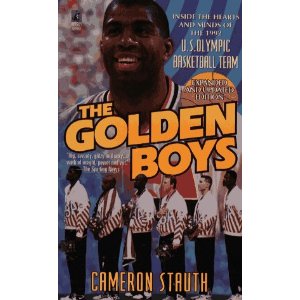
First off, if you haven't read Stauth's book then I suggest you venture over to Amazon and grab a copy ... you can snag one for less than $10 (hardcover). His book gives an unauthorized look at the selection process, detailed stories on each player from childhood to the NBA and some nice behind the scenes stuff. So, if you want to know more about head coach Chuck Daly, Magic Johnson, Larry Bird, Michael Jordan, Scottie Pippen, Clyde Drexler, John Stockton, Chris Mullin, Charles Barkley, Karl Malone, David Robinson, Patrick Ewing, college star Christian Laettner and other who didn't make the team (like Tim Hardaway and Isiah Thomas) then this is a great book to get some background on players that you either remember watching or maybe guys who you really never got to see play.
A couple story lines that I had no clue about ... Laettner's almost entire background. The only thing I really remember or wanted to know about Laettner was that he played for a college team I despised and he personified those unlikeable teams. I had no idea that he liked to keep his sexuality mysterous to frustrate the media or realized that he was such an asshole while he was at Duke. I also never knew much about Mullin and had no idea he was almost out of the league before his career even took off because of alcohol problems. I've read, watched shows and plenty of games about the other guys on the team, but there was even a few tidbits that were definitely helpful in understanding more the guys I remember most while growing up watching the NBA. I love getting to put some real life stories behind the guys I used to watch who play the game I love the most.
Golden_boys_medium 

Anyway...while reading this book I found myself doing what any good book should make you do ... question the shit out everything while you're reading it. Now, I don't mean I'm questioning Stauth's facts or tales, but rather just how much his subjects helped shape and change the NBA. We all know that The Dream Team gets basically all the credit for taking the game global and popularizing it outside of the United States. And we all can see how the influx of foreign players over the years has had a good amount to do with The Dream Team. But what we may not be totally appreciating is what the "outside" world eventually gave back to the NBA.

Style of PlayOn page 205 in Stauth's book we get this passage after a college squad brought in by coach Chuck Daly beat The Dream Team in a scrimmage:
"The U.S. pros, the reporters pointed out, had ignored the perimeter players when the ball had gone inside, only to have the ball passed back outside for a quick three-pointer. It was the classic penetrate-and-pitch European strategy that the Selection Committee's Bob Bass had warned about last summer. Now it was working! Against the golden boys! Horrors!"
Is it true that the penetrate-and-pitch strategy is European? Well Stauth again references it on page 228:
"Jordan sidearmed a pass to Mullin, who was waiting--all alone--just outside the three-point line. Rip! It was classic European-style basketball: penetrate and pitch. It had taken the U.S. about a week to perfect it."
Go ahead and think of a team in the NBA that utilizes the penetrate-and-pitch strategy. Got one? Got two? Got 15? How about all of them? The most famous p-and-p team of the past decade? They'll be playing for the right to represent the Western Conference starting Monday, May 17th, the Phoenix Suns.
The Suns did adopt an offensive strategy devised by Mike D'Antoni, who had a famous career in Europe, and they have been trying to win an NBA championship with that style ever since. What will that say about the American game if the Suns are able to win a championship with a style born overseas? It's an interesting thing to think about.

Magic_and_bird_mediumWho saved the NBA?Some people would say that Michael Jordan saved the NBA. Others would argue that Earvin "Magic" Johnson and Larry Bird saved the NBA and Jordan helped push that popularization over the hump. I would agree with the second of those two points. Bird and Magic were responsible for getting the NBA off tape delayed viewings and Live into our homes. Jordan though spawned the age of the Super-Duper Star. The ability for a player to "take over" a game has been around since the first peach basket was erected, but Jordan did it in front of millions of people and did it in a way that influenced kids all over the planet.
I'm sure those older than me can remember a guy taking the ball to the top of the key, isolating himself with his defender and then going to work, but did anyone ever do it the way Michael did? Jordan's one-on-one popularization is still in the league today ... we saw it (see it) with those who tried to take Jordan's torch: Allen IversonVince CarterKobe Bryant, Dwayne Wade, Carmelo Anthony and LeBron James. What we have now is a blend of team basketball, with strategies like the penetrate-and-pitch, combined with spurts of the old Jordan game of the isolation play.
NBA basketball has always been a melting pot of ideas and strategies ... and it will continue to evolve.

Where do loyalties lieTrades have always been a part of the game and more recently free agency has become a staple of the NBA. We all know the days of a player spending his whole career with one team are a very rare thing. It looks like Tim Duncan will be able to spend his entire career in San Antonio (remember he almost signed with Orlando way back when) and Kobe Bryant might just be a "Laker for life." On The Dream Team only 4 of the 11 members spent their entire careers with their original team. Can you name them? (I'm not counting Laettner in this.)
Here is the list: John Stockton, Larry Bird, Magic Johnson and David Robinson. Some of you may include Michael Jordan on that list, but the Wizards thing did happen. So, seven players considered the best in the world to be placed on this mighty team were at some point changing uniforms. This seems crazy to me ... it also seems crazy how a guy like Shaquille O'Neal can be considered so great, yet he has now tossed on five different uniforms and maybe even six or seven before it's all said and done. I've never quite understood how a guy can be so great, yet also deemed expendable by his team ... although I realize the business side plays its role. But it is somewhat crazy right? Am I alone here? Ok ... fine, I don't mind being alone.
With the popularity of Fantasy Sports I'm afraid that more and more people, especially younger people, will root more for the names on the back of jerseys than the names on the front. And with player movement in the NBA resembling Fantasy teams or even videogame juggling people's loyalties are being tested. If you grow to like a player's game in college, like many did with Carmelo Anthony, then you became a Nugget fan (we have all sorts of readers here for that reason alone), but what happens when a player you are loyal to changes teams? What happens when it becomes so regular that teams should stop putting names on the back of jerseys because the faces change too much? Will we see that day? Am I too paranoid? Were there ever days when teams stayed together? The famous Bill Simmons waxes on and on about his 1980's Celtics teams led by Bird, Kevin McHale and Robert Parrish, but that was back when the rich got richer and pillaged the smaller teams. We are not far from those days now and we see it happening with the Lakers, Celtics, Magic and Mavericks.
The balance between playing for fun, playing for money and being loyal is a tricky one. Loyalty plays a role with the fans, the players and the owners. It'll be hard for me to say goodbye to this current Nuggets team, just as it was difficult last year and every year before that.

I like stepping back and looking at the game of basketball as a whole. I also just like to ramble about nothing in particular sometimes. Reading will get my gears grinding, but it doesn't always get them moving an any sort of productive direction.
I think I need to go shoot some hoops ... maybe work on my penetrate-and-pitch as a writer as well.

This afternoon the Senate failed to break a Republican filibuster of the DREAM Act, and voted


This afternoon the Senate failed to break a Republican filibuster of the DREAM Act, and voted, finally, to repeal the military's Don't Ask, Don't Tell policy on gays and lesbians in the military.
Viewing today as a microcosm of religious political activism, these two votes caused me to wonder: do elected officials give a damn what religious activists have to say?
Let's take DREAM first: there was a pretty wide coalition of religious activists who supported DREAM and brought their message to the Hill. The activists included long-time proponents of immigration reform, including Protestant denominations and Jewish groups, as well as some relative newcomers to the immigration reform fight. Conservative evangelicals came out for DREAM, and even for comprehensive immigration reform (if it doesn't include equal justice for gays and lesbians). The coalition group Conservatives for Comprehensive Immigration Reform included representatives of the National Association of Evangelicals and some religious right organizations. You know, the ones with all the pull because they represent such a crucial slice of the Republican vote.
But even that couldn't move opponents of justice for undocumented children. Sure, a lot of religious right groups, like Concerned Women for America and Eagle Forum, oppose the DREAM Act. There's a split in the religious right over immigration policy (let's call it a divide between the "broader agenda" evangelicals and the Americanists with their feet still locked in the 1950s). But why, given that the pro-immigration reform camp was in agreement with mainline Protestants, Jews, social justice Catholics and other liberal religious constituencies that have been in the trenches on this issue far longer, could they not push the Senate on that arc of justice?
On Don't Ask, Don't Tell, conservative religious opposition seemed not to matter, either. The final vote against this backward -- shall I say it? -- abomination was decisive: 65-31, with eight Republicans voting with the Democrats for repeal. That's a pretty amazing rebuke to the religious right, and all its bogus fear-mongering and primary threats. What mattered more was the support for repeal from the military brass.
Some might view this as a victory against the homo-hating religious right, and it is. Although it was their influence that made this battle so protracted, in the end, their position was decisively rejected.
As I was writing this, though, I received a press release from Liberty Counsel -- whose president, Mat Staver, was one of the conservative evangelicals who supported the DREAM Act -- on behalf of the Freedom Federation, a coalition of religious right groups that claims to be reaching out beyond the religious right's historically white base. The first words on the subject line were, "Freedom Federation Pledges Full Mobilization on Behalf of . . ." and I thought, ah, they're getting up in arms about the failure of the DREAM Act. But, sadly, no, it's a promise to mobilize a claimed 40 million supporters "to overturn DADT repeal."

A Dream and its Influence


During August of 1963, I was enjoying the summer before my senior year of high school. Dr. Martin Luther King gave his famous "I Have a Dream" speech that month at the March on Washington. It was responsible for my becoming aware of the fact that I had grown up in an "all white community." For most of my life I had had the feeling of being different, but, three years earlier, I had found out that I was Jewish. My parents had hid this fact in order to blend in. Why, we even had Christmas lights on our house every year.
The above incidents were strong forces in building a desire to explore both spiritual and political issues. My parents had taught me that the three things one should never discuss were: POLITICS, RELIGION & OTHER PEOPLE'S CHILDREN. I was now disregarding the first two items in this advice.
After my senior year, I went to a local community college and became more and more involved in the political realm. With the draft registration, I became aware of the "Police Action in Viet Nam." I began to protest not only of Viet Nam, but the racial conditions that existed in this country. It was not until college that I made my first black friend. It was also at this point in time that I came in contact with various religious and spiritual points of view. These helped to develop my growing awareness of the racial issues.
My disgust for prejudice continued to grow during my time in the Army. I met people that would not accept a blood transfusion from any but a white person, even if the alternative to this was death. My circle of friends from diverse backgrounds and races grew, and so did my awareness of the spiritual, political and social implications of discrimination. This awareness has continued to expand.
One dramatic change was moving from California to Georgia. I came face to face with many preconceived notions that I had held for many years. My vision of the South was formed by the movie "Easy Rider." The reality was quite a bit different. It was in Georgia that I began to learn of The Baha'i Faith. My girl friend, latter to become my wife, was a Baha'i. After over a year of study and, more importantly, personal interaction, I became a member of the Baha'i Community. I have now been a member for over 20 years and have come to believe that the solution to the racial issue is a spiritual solution, not a political one. Yes, changing laws will help, but, I truly believe that it is only through the change of one's heart that will allow prejudice to disolve and a true understanding of Dr. Kings words,
The copyright of the article A Dream and its Influence in Baha'i Faith is owned by Lloyd Madansky. Permission to republish A Dream and its Influence in print or online must be granted by the author in writing.